
Behavioral Health Workforce Pipeline
Building education-to-employment pathways in behavioral health across the Eastern Panhandle.
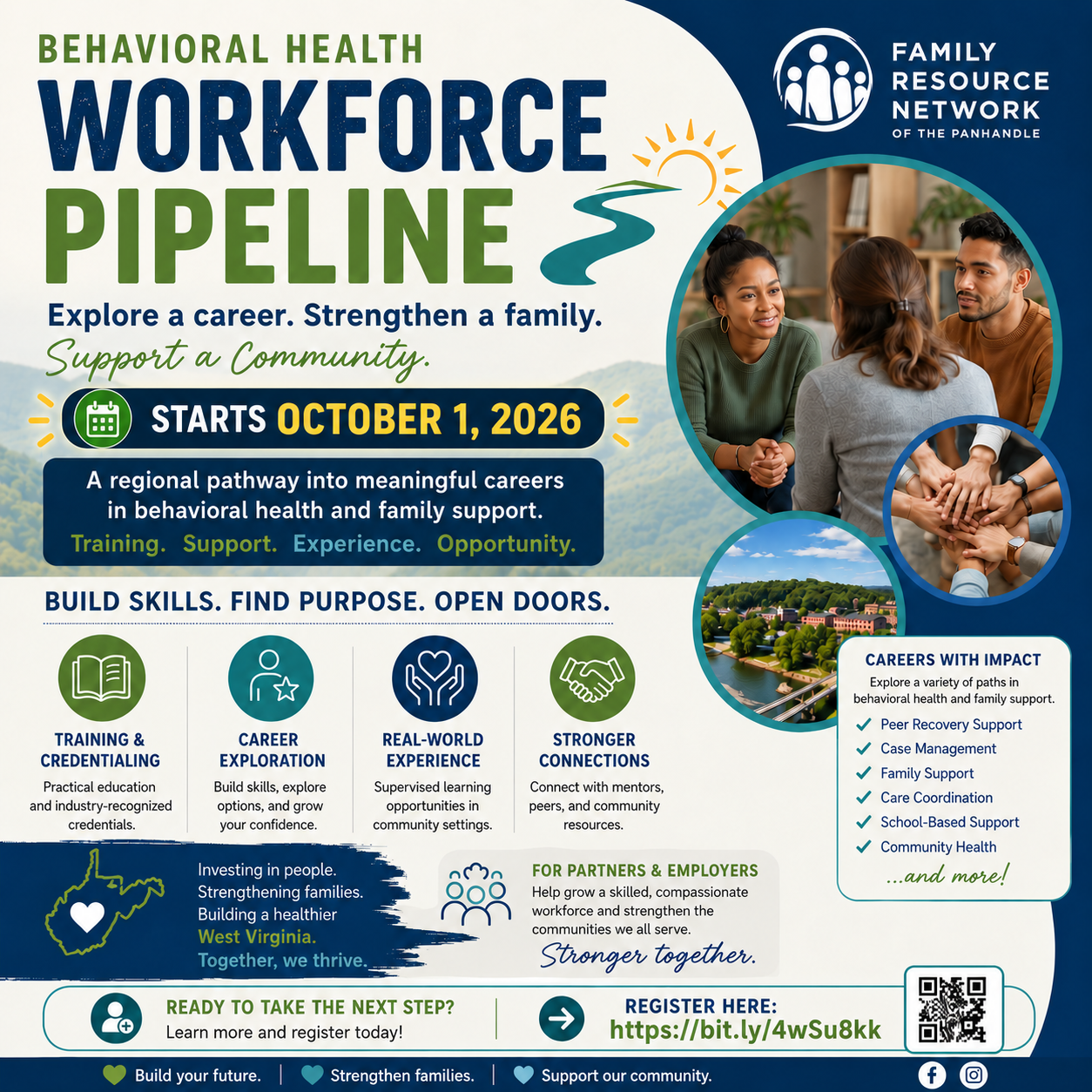
Explore a career. Strengthen a family. Support a community.
The Behavioral Health Workforce Pipeline is a free, regional pathway into meaningful careers in behavioral health and family support across Berkeley, Jefferson, and Morgan Counties.
Not sure whether your experience fits? Sign up anyway — we can talk through your goals, options, and available supports.
The pathway
Research that connects the 3 steps from classroom to career.
What the program offers
Twelve weeks of training, plus the workforce support that helps it lead somewhere.
Training & skill building
Practical, trauma-informed skills for helping roles in behavioral health, recovery, schools, healthcare, and community settings.
Support before placement
Guidance on expectations, paperwork, readiness, and next steps before entering a field placement or employer setting.
Field experience
Build confidence through workplace tours, job shadowing, supervised field experience, and related learning activities.
Employer connections
Connect with organizations that need caring, prepared workers — and learn how to move from training toward employment.
Is this program for someone like me?
You do not have to already be a licensed professional. This program is designed to help you learn, prepare, and move forward with support.
Students
In social work, counseling, psychology, human services, education, or related fields.
Adult learners & jobseekers
Parents, caregivers, rural residents, and anyone looking for a purpose-driven career path.
People with lived experience
Peer recovery workers, and anyone interested in peer support who wants to help others.
Frontline workers
Already working in nonprofits, schools, recovery, healthcare, or community services and ready for a next step.
Careers with impact
Potential career paths include:
Facing a barrier? If transportation, scheduling, technology access, or childcare could affect your participation, reach out anyway — the program can help identify available supports.
Not sure whether your experience fits? Sign up anyway — we can talk through your goals, options, and available supports.
How to get started
Program resources
Download, print, and share these with anyone who might be a fit.
Program overview
Build a Career That Helps People in the Eastern Panhandle — who it is for, what it offers, and what to expect.
PDF · 3 pages
Download PDFRecruitment handout
Behavioral Health Workforce Pipeline — the one-page overview to share.
PDF · 1 page
Download PDFFor veterans
Your Next Mission Starts Here — turning service-earned strengths into a civilian helping career.
PDF · 1 page
Download PDFFrequently asked questions
Do I need a degree?
No degree is required to express interest. Some roles or credentials may have specific requirements, which will be explained before enrollment.
What does it cost?
Nothing. This is a no-cost training.
How long does it take?
Twelve weeks of training, with the overall program running less than six months.
Is it online or in person?
Trainings will be held online, but some in-person time may be required depending on specific program needs.
Will I receive a credential or certificate?
Yes. Participants who complete the required steps will receive a credential or certificate, where applicable.
What if I am not sure it is right for me?
Sign up anyway. We can start a conversation about your goals, options, and the supports available to you.
Not sure whether your experience fits? Sign up anyway — we can talk through your goals, options, and available supports.
Partners & practicum
Help grow a skilled, compassionate workforce and strengthen the communities we all serve. FRNOTP works with educational institutions, employers, and providers across Berkeley, Jefferson, and Morgan Counties to create field experience, placement, and credentialing opportunities for people moving into behavioral health and family-support roles.
Host a field experience
Offer a workplace tour, job shadowing, or supervised field experience so participants can build confidence in a real setting.
Offer a practicum placement
Partner with us as a placement site and help participants meet the practical requirements of their pathway.
Hire from the pipeline
Connect with prepared, trauma-informed candidates for peer support, family support, case management, and related roles.
Stronger together. Want to help support this programming? Tell us how you would like to connect and we will follow up.
Register your interest
Tell us you are interested and a member of the team will follow up with details about the next cohort. The form takes about two minutes.
Not sure the program is right for you? Complete it anyway — we can talk through your goals, options and any barriers to taking part.
Opens in a new tab · about 2 minutes
The interest form is hosted on Google Forms. We use the details you provide only to contact you about the Behavioral Health Workforce Pipeline.
State FRN Disclaimer: This resource is being presented with financial assistance as a grant from the West Virginia Department of Human Services.